
July 23rd, 2009

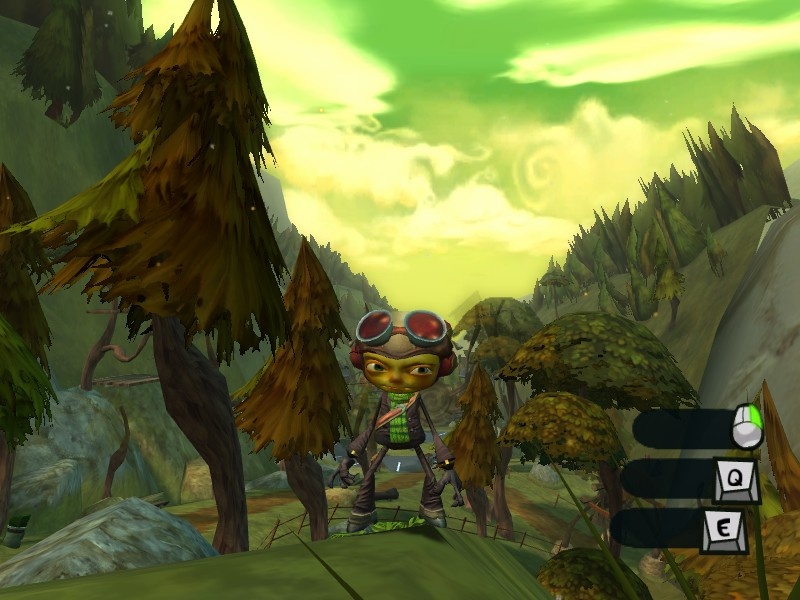
Raz at summer camp, aka Psychonauts training grounds“Mmmm… Bacon!” If that doesn’t ring a bell in your ear, you may have a gaming nutrient deficiency. Previous sources of this vitamin include the Monkey Island games and Grim Fandango. The most potent of Tim Schafer games, however, is the mind-blowing Psychonauts, released by Double Fine Productions in 2005. Initially overlooked by most gamers (except maybe the color blind), Psychonauts went on to garner Gamespot’s “Best Game No One Played” award among numerous other commendations for writing and voice acting.

The story begins with Raz sneaking into summer camp. You know, the one where it’s actually a secret government training ground for psychic soldiers, also known as Psychonauts. Consequently, his dad is called to pick him up, so Raz is determined to train as much as possible before that happens. What Raz doesn’t know yet is that he’s more special than the other kids at the camp (and trust me, there’s some “special” kids there). What’s more, it’s the start of an adventure only a madman like Tim Schafer could produce.
Continue »

July 21st, 2009

By now, especially if you’re a listener of such gaming podcasts as A Life Well Wasted, Out of The Game or the Bitmob Mobcast, you may have caught wind of the self-titled debut album from Robert Ashley and Sam Frigard’s genre-defying band I Come to Shanghai. Robert and Sam’s labor of love was three years in the making, having co-written and co-produced each of the album’s ten tracks themselves. “Another Sunday Morning,” the song I’ve selected to feature below was, as I understand it, written foremost by Robert Ashley, and is one that I like on a personal level very much.

I Come to Shanghai is being distributed under Creative Commons with a “name your price” model at the band’s official website.

July 18th, 2009

I am so glad that these Civony/Evony people are finally getting called out. Their shady ads featuring stolen art assets are everywhere. I can only hope they haven’t tricked many people into playing, but I know that mammary glands are powerful things.

This is a big one, and I will admit that I skimmed a bit, but there’s some interesting stuff here. Particularly, the acknowledgment that the general perception of the PC gaming market’s health is largely due to a lack of marketing and representation; that’s interesting coming from a PC manufacturer, not to mention a founder of the PC Gaming Alliance. Next up: much respect to Chris Remo for not letting the comment about $1,500 – $2,500 being what somebody needs to spend on a gaming PC slip by. The notion that a person needs to spend more than $700 to play any game is one that is hurting the platform. Finally, I very much like the idea of Steam being pre-installed on Dell and Alienware systems. I’m no fan of crapware, but if they’re injecting new machines with a bunch of it anyway, they may as well throw in something great like Steam.

This just tickled me.

July 16th, 2009

The PC is treated as a second-rate game platform. This is evidenced most strongly both by game publishers’ treatment of the PC versions of their multi-platform games as well as how the games press covers PC games whether they be multi-platform or exclusive. For roughly the last six years the PC has been perceived as being a dying platform. While some players have definitely shifted from PC to video game consoles during this same time frame, things aren’t that bad; the PC platform’s biggest problem is still the perception that gamers, game makers, and game journalists have of it. This problem, left to fester, has begun to have distinct effects on the way PC games are treated.

Publishers, when they even make a PC version of their game, don’t treat it as well as they do the console versions. Development of the PC version of multi-platform games is often outsourced to a third party, and the quality of the product suffers as a result. But it isn’t always a problem of outsourcing; sometimes developers are simply told to focus their foremost efforts on the console versions. Marketing of the PC version also takes a hit; it is not uncommon for the PC version of a game to be released weeks to months after the console versions. Rarely will the PC version even be mentioned in magazine and comic book ads, much less television adverts; it will just be tossed out and left up to word of mouth and the virtually non-existent retail spaces to sell it to people.
Continue »

July 14th, 2009

In addition to being an animator, illustrator, and photographer, Silence (A.K.A. Vincent Girès) is a composer of electro tracks for what he calls his Copyleft Music Project. Music from Silence’s latest album, L’autre endroit, was used for the soundtrack of Chains, an indie-puzzler featured here previously at DoSu. The particular song ridden through below, “Open Electro,” is from the self-titled album Silence. The rest of Vincent Girès’ music, as well as his visual art, can be found through his website Untitledocument.net.

July 11th, 2009

I am ambivalent to this bit of news. It would be unfortunate if Microsoft decides not to bring Alan Wake to PC, but I can’t say that I would be surprised. Very little concerning Alan Wake’s very existence was anywhere near set in stone until this year’s E3, after all.

No, wait. Come back; this is a top 10 list that isn’t terrible.

I got a big kick out of this article. Enjoy.

July 9th, 2009

Level 2: The GateChains is a puzzle game created by independent developer 2DEngine.com, and published by Meridian4. Released in November of 2008, Chains is the first game to be built on 2DEngine.com’s proprietary cross-platform game engine AGen, which they make freely available for non-commercial development.

There is only one direct action to make in Chains: link three or more circles together. Though the means may be simple, the scope of Chains’ gameplay is anything but narrow; this is not a run-of-the-mill “match 3” game. Never mind the smooth, minimalist art style facilitated by vector graphics, or the haunting electro soundtrack; simply consider that each of Chains’ twenty levels presents for players a different objective and a different obstacle. Take, for example, stage 2, “The Gate” (pictured right), wherein the objective is to clear 200 bubbles before their collective weight becomes greater than the counter-weight keeping the gate below them closed. Compare that time-based level with something more relaxed like stage 7, “Gulliver”, where the objective is to clear 100 bubbles by creating 10 chains or less, and it becomes apparent that Chains offers something uniquely challenging from level to level.
Continue »