
July 16th, 2009

The PC is treated as a second-rate game platform. This is evidenced most strongly both by game publishers’ treatment of the PC versions of their multi-platform games as well as how the games press covers PC games whether they be multi-platform or exclusive. For roughly the last six years the PC has been perceived as being a dying platform. While some players have definitely shifted from PC to video game consoles during this same time frame, things aren’t that bad; the PC platform’s biggest problem is still the perception that gamers, game makers, and game journalists have of it. This problem, left to fester, has begun to have distinct effects on the way PC games are treated.

Publishers, when they even make a PC version of their game, don’t treat it as well as they do the console versions. Development of the PC version of multi-platform games is often outsourced to a third party, and the quality of the product suffers as a result. But it isn’t always a problem of outsourcing; sometimes developers are simply told to focus their foremost efforts on the console versions. Marketing of the PC version also takes a hit; it is not uncommon for the PC version of a game to be released weeks to months after the console versions. Rarely will the PC version even be mentioned in magazine and comic book ads, much less television adverts; it will just be tossed out and left up to word of mouth and the virtually non-existent retail spaces to sell it to people.
Continue »

July 11th, 2009

I am ambivalent to this bit of news. It would be unfortunate if Microsoft decides not to bring Alan Wake to PC, but I can’t say that I would be surprised. Very little concerning Alan Wake’s very existence was anywhere near set in stone until this year’s E3, after all.

No, wait. Come back; this is a top 10 list that isn’t terrible.

I got a big kick out of this article. Enjoy.

July 9th, 2009

Level 2: The GateChains is a puzzle game created by independent developer 2DEngine.com, and published by Meridian4. Released in November of 2008, Chains is the first game to be built on 2DEngine.com’s proprietary cross-platform game engine AGen, which they make freely available for non-commercial development.

There is only one direct action to make in Chains: link three or more circles together. Though the means may be simple, the scope of Chains’ gameplay is anything but narrow; this is not a run-of-the-mill “match 3” game. Never mind the smooth, minimalist art style facilitated by vector graphics, or the haunting electro soundtrack; simply consider that each of Chains’ twenty levels presents for players a different objective and a different obstacle. Take, for example, stage 2, “The Gate” (pictured right), wherein the objective is to clear 200 bubbles before their collective weight becomes greater than the counter-weight keeping the gate below them closed. Compare that time-based level with something more relaxed like stage 7, “Gulliver”, where the objective is to clear 100 bubbles by creating 10 chains or less, and it becomes apparent that Chains offers something uniquely challenging from level to level.
Continue »

July 7th, 2009

It’s Minimalism Day, again. I couldn’t find any information about today’s artist, A Truly Inspiring Piece of Wax. But they have a great name. Also, their songs are great, plus they’re free; that is also great. Ride 3 Ghosts:

June 25th, 2009

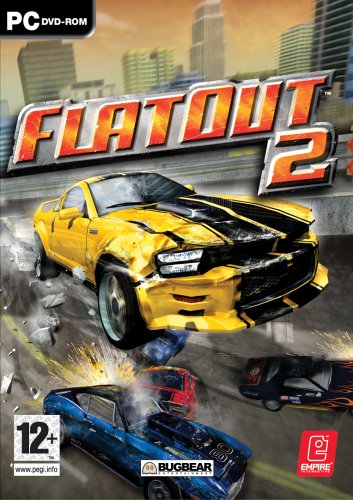
This is what the box looked like. But who needs boxes?FlatOut 2 is an arcade-style racing game developed by Finnish studio Bugbear Entertainment and published by Empire Interactive. It was released in the US in August of 2006 for PC, Xbox, Playstation 2, and again in October of 2008 for Mac OS X.

FlatOut 2 is a racing game that offers something for everybody. Single race, stunt or derby modes will best suit the dabbler. Just pick a mode, a track, a vehicle, and get to racing, death-defying, and destroying your way to victory. There is nothing to unlock, to buy, to sell or to upgrade. Some prefer to earn their keep, though, so for the arcade-racing purist there is a full career mode complete with the aforementioned unlocking and shopping as well as classes, cups, tournaments and special events. FlatOut 2’s modes can also be taken to multiplayer games via party-play (local), Internet (where a healthy group of people can still be found playing), or LAN. No matter your poison, FlatOut 2 is always all about the mayhem with its destructible environments, brutal crashes, tons of debris, and AI-controlled drivers that are not afraid to get their hands dirty.
Continue »

June 23rd, 2009

Macroform is an ambient electronic artist whose music can be a little tricky to find all in one place. The most comprehensive sources seem to be a page on OPSOUND and a Bandcamp website — complete with visualizers. I also came across what appears to be Macroform’s blog. The song featured below, Seeing In Purple, inspired me to do something a bit different with the video than I normally do; I hope you like it.

Macroform is an artist from the Troy, Ohio, USA. He is a musician, drummer, percussionist and computer musician, who also dabbles in guitar and piano and found sound in general to create sketches and compositions reflecting the worlds both internal and external. He draws from a broad range of musical influences from alt. rock to the net label scene at large. Many have found his music both cinematic and evocative. Delve in and find out how much your ears will find.
June 20th, 2009

Ooh! fanboy fodder! Really, though, this is a good thing. Activision won’t seriously ever stop supporting Sony consoles. This is actually one of the least-evil things they’ve done or said lately. It’s a fact that the Playstation 3 is too expensive. Most gamers agree, most of the press agrees, and the sales numbers of multiplatform games make developers inclined to agree. Any other day I’d be jumping at the chance to hate on Activision, but as a person who wants to play some PS3 games, but doesn’t have a PS3, they’re right; that machine’s too expensive.

It’s going to be great when we no longer need to ask questions like this.

Yes, you read it right. The Ghostbusters developers didn’t include multiplayer in the PC version so that they could make the console versions better. Meaning the Xbox 360 version, apparently, since the Playstation 3 version renders at a lower resolution and has lower resolution textures. To be fair, the PC version is $30 instead of $50, but I’d rather have more co-op and less $20.